Marine Verdun Loos James Pierpoint
Verdun as one can see was named after two of the most famous battles of WW1. Born on the 31st October 1916, he was the son of William and Annie Pierpoint (nee’ Blunsden). Father William (who served with the 14th Battalion Worcestershire Regiment from 1916-18) was a bricklayer working for Wheeler & Co in Mill Street. Verdun had 11 siblings. Of his brothers four served in WW2, George (with the Military Police), Bill (Royal Artillery), Frank and Desmond (both with the Royal Berkshire Regiment). After leaving school, Verdun worked as an errand boy for Nichols & Son stationers and printers in the Market Place where also his brother Desmond worked as a printer. He was also a keen cricketer , playing for the Wesleyan School team.
According to a family story, in 1933, Verdun stole some money from his employer, and his father William found out, and gave him so much hassle over what he had done, Verdun left home to join up.
Overseas to Suez and posted to HMS Nelson
Verdun’s first overseas posting was to Egypt for a year where the British retained control over the Suez Canal and the Royal Marines helped to provide security for this ensuring passage for ships to India, the Far East and Australia.
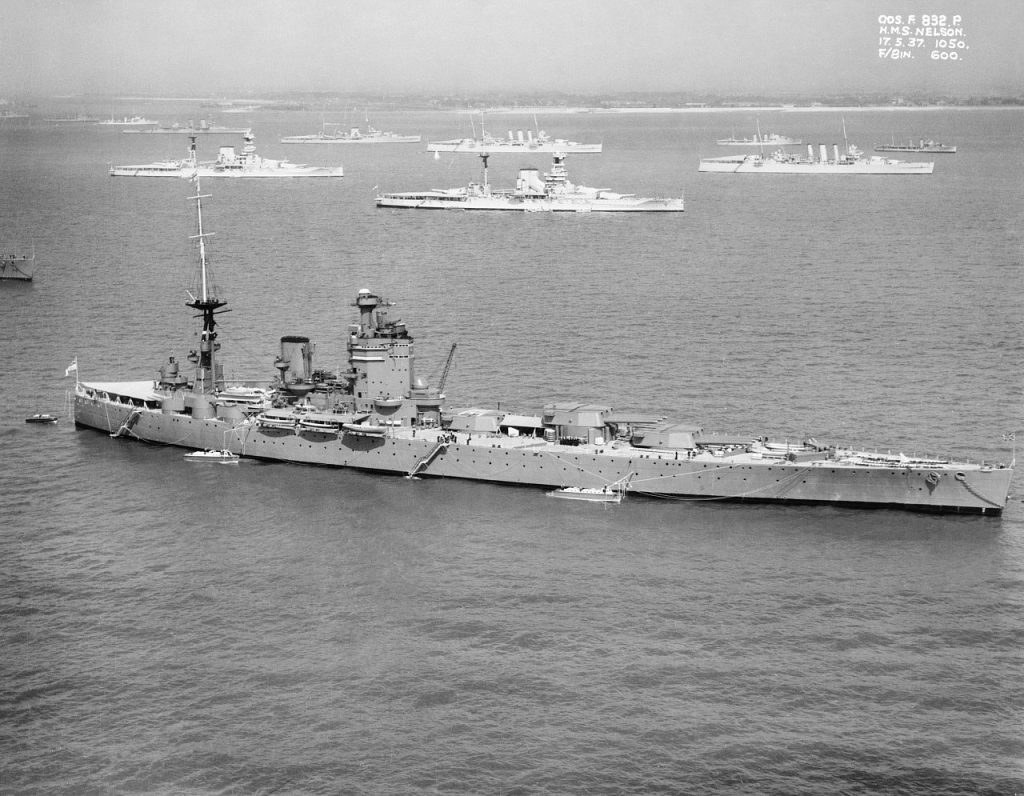
On return from Egypt, Marine Pierpoint was posted to HMS Nelson on 11th April 1937. HMS Nelson was one of two Nelson class battleships built between the two World War (the other being HMS Rodney). They were unique in being the only ships carrying a main amament of nine 16” guns, all of which were carried forward of the superstructure. It was the role of the Royal Marines on board to man these guns.
Verdun adopts James as his surname instead of Pierpoint.
It was whilst serving aboard HMS Nelson in July 1938, that Verdun decided to adopt James as his surname instead of Pierpoint. The reason for this is not clear at the present time, but this is the surname by which he is known in records from this date onwards. After leaving HMS Nelson , in April 1939, Verdun James was based at Portsmouth and he was here in June 1939 to join HMS Royal Oak when it arrived in port. Here new members of the crew were issued with tropical clothing in the belief that the ship was going to the Mediterranean. However with war seeming to be inevitable this was cancelled and HMS Royal Oak headed north instead.
HMS Royal Oak at Jutland
HMS Royal Oak was the last and largest battleship to be built at Devonport, launched in 1914 and completed in 1916. She was armed with eight 15 inch guns contained in four turrets , plus an assemblage of 6 inch guns, anti-aircraft guns and four torpedo tubes. Heavily armoured with 13 “ steel armour extending 5ft below the waterline, the Royal Oak was a very powerful ship and needed a crew of over 1000 to maintain her. During World War 1 HMS Royal Oak took part in the Battle of Jutland.
Sighting of the German Battlecruiser Gneisenau
By the start of WW2, the Royal Oak was over 20 years old, slow and outdated, but still needed by the Royal Navy. She was at anchor at Scarpa Flow in the Orkneys, attached to the Home Fleet, when war was declared on the 3rd September 1939.
On the 9th September 1939, the CinC Home Fleet received information from the RAF when a Hudson from 224 Squadron of Coastal Command signalled that it had sighted the German Battlecruiser Gneisenau, cruiser Koln and 9 destroyers steaming north off the coast of Norway.
That evening, HMS Royal Oak along with the destroyers Matabele and Sturdy set sail to patrol to the west of the Shetlands. Due to her slow speed HMS Royal Oak did not sail with the rest of the fleet. She had been given the task to act as a ‘backstop’ should Gneisneau elude the rest of the fleet and attempt to break out into the Atlantic.
U-47 penetrates the line of block ships at Kirk Sound
On the night of 13th/14th October 1939, U-47 penetrated the line of block ships at Kirk Sound and a lookout spotted the outline of a battleship. As it was 1 o’Clock in the morning, the vast majority of the crew were asleep. The U-47 fired a salvo of three torpedoes. Two missed, but the third struck the bow of the ship at 01:04 shaking the ship and waking the crew. Many of the men on board heard a muffled ‘whump’ and were unsure of what caused it. It was suspected there had been an explosion in the ship’s forward inflammable store. An announcement was made over the ship’s tannoy for this to be checked, but many sailors returned to their hammocks unaware that their ship was under attack.
HMS Royal Oak takes more torpedo hits
The U-47 attempted another shot via its stern tube, but this too missed. Reloading the submarine tried again with a spread of three further torpedoes, and this time there was a large explosion underneath the Royal Oak and she rolled over and sank within minutes. By 1:30am all there was to be seen was fuel oil and survivors in the water desperately trying to survive.